Devices arrived faster than the wiring did
One-to-one device programmes spread widely, and the constraint turned out to be network and support rather than hardware.
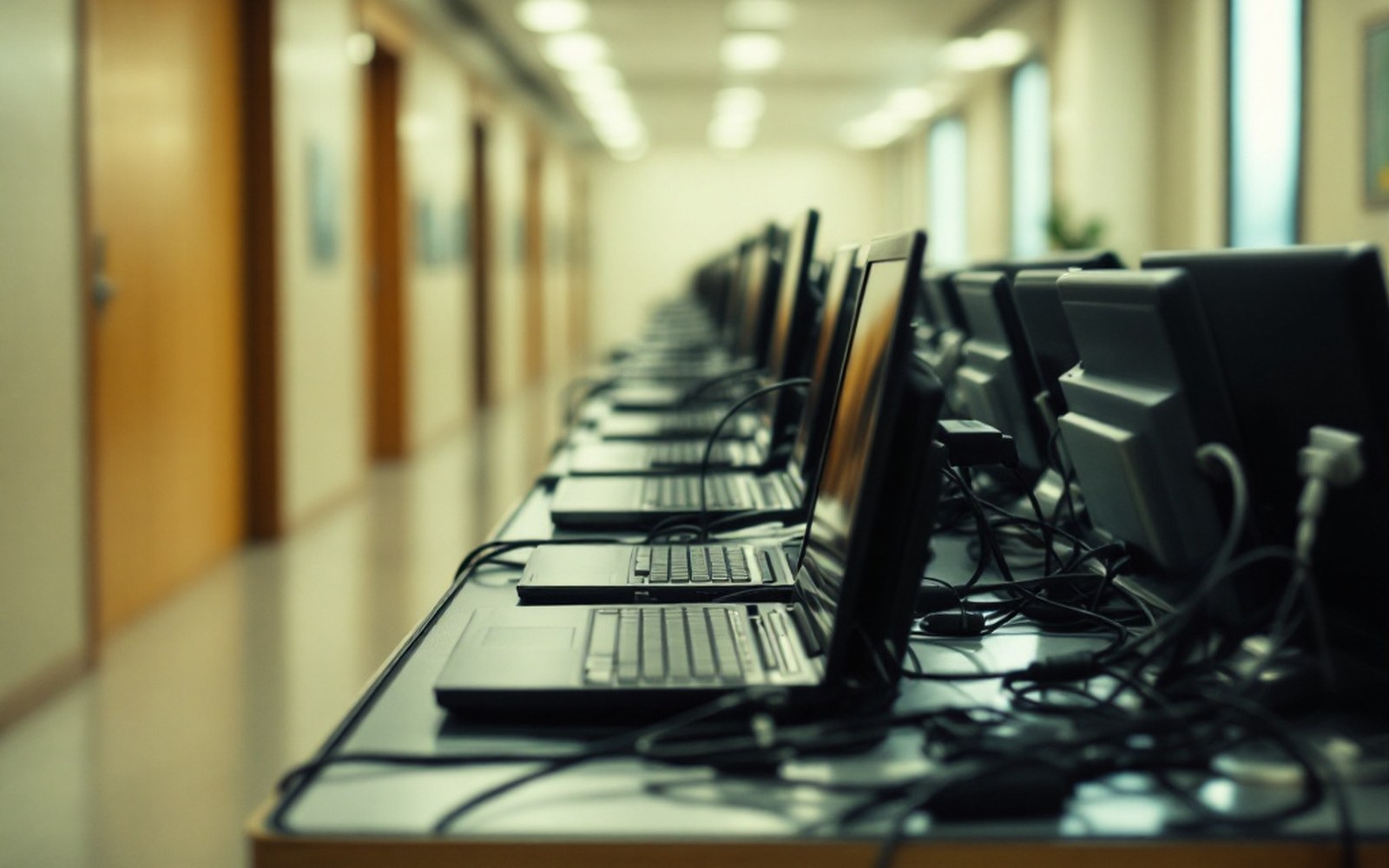
When every student has a laptop, the question becomes whether anything happens when they open it
The hardware came quickly. Between roughly 2010 and 2020, the number of students sharing a single computer in American public schools fell from several per device to approximately one-to-one, a shift accelerated sharply by the pandemic years when districts spent emergency federal relief funds on Chromebooks and tablets at scale. The devices were visible, countable, and easy to report to a school board. What happened after the cart arrived in the classroom was harder to count and, it turned out, harder to fix.
The problem was infrastructure. A school built in the 1960s or 1970s — and a large share of American school buildings were, since the building stock ages alongside the district's capacity to replace it — was wired for a world of fluorescent lighting and intercom systems. Running adequate Wi-Fi through masonry and concrete demands either a recent renovation or a purposeful retrofit: access points placed at the right density, cabling run through walls that were not designed to receive it, and electrical panels that can handle the additional draw. Many districts had the devices before they had any of those things.
The E-Rate programme, administered through the FCC and formally called the Schools and Libraries Program of the Universal Service Fund, was the primary federal mechanism for subsidising telecommunications infrastructure in schools. Created under the Telecommunications Act of 1996, it helped districts pay for broadband connections and internal network upgrades. But E-Rate funding was subject to application cycles, funding caps, and the administrative overhead of a competitive bidding process — a sequence that favored districts with grant-writing staff and punished smaller or lower-capacity systems. A district might receive funds for a fibre connection to the building while still lacking the internal wireless infrastructure to distribute that signal to thirty devices in a classroom on the third floor.
Device management added a second constraint. A one-to-one programme means a fleet: software licences to maintain, devices to repair or replace when they break, user accounts to provision, and filters and security policies to enforce. This is not work a classroom teacher does. It requires a dedicated technology support function, and many districts — particularly those in rural areas or those managing tight general-fund budgets — were running one-to-one programmes with support staffing ratios that would have been thin even for a single building. Deferred maintenance in the physical plant has a direct analogy in technology: a device not updated, a licence not renewed, an access point not replaced when it fails.
The home side of the connection mattered too. Research documented consistently through the 2010s that students in low-income households were less likely to have reliable broadband at home, a gap researchers named the "homework gap" to distinguish it from the school-based access question. A Chromebook carried home on Friday evening was only as useful as the connection available at the other end. Districts that recognised this began negotiating with carriers, deploying mobile hotspots, or lobbying for E-Rate expansion to cover off-campus connectivity — but these were improvised responses to a structural mismatch rather than a designed solution.
The 2018 NAEP Technology and Engineering Literacy assessment offered one lens on the gap between device availability and actual digital capability. It measured not hardware access but functional competency with technology — and found substantial variation across demographic groups, variation that access statistics alone did not predict. Having the device was a necessary condition, not a sufficient one.
What the device rollout clarified, in the end, was that the school plant is not only the roof and the boiler. Network infrastructure, electrical capacity, and the support staffing to maintain them are now load-bearing parts of a functional instructional environment. A district that treats device procurement as the whole project and defers the wiring, the staffing, and the home connectivity as secondary will find that the cart full of Chromebooks reproduces, in a different register, exactly the pattern of underfunded infrastructure it was meant to solve. The hardware budget is visible. The budget for what makes the hardware work is not.
- 1996Telecommunications Act creates the E-Rate programme
- 2010–2020Student-to-device ratios in public schools approach one-to-one
- 2018NAEP Technology and Engineering Literacy assessment administered
- 2020–2021Pandemic emergency relief funds accelerate district device purchases at scale
| E-Rate (Schools and Libraries Program) | FCC-administered subsidy for school broadband and internal networking; created 1996 |
| ESSER funds | Elementary and Secondary School Emergency Relief; federal pandemic-era funding used heavily for device procurement |
| Homework gap | term used by researchers for the disparity in home broadband access across income levels |